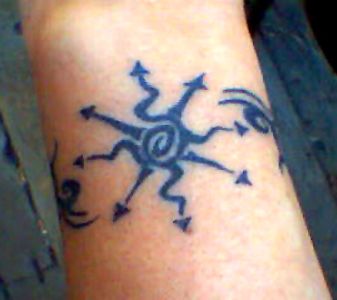
I wanted a tattoo when I was about 19 or so. I imagined it, drew it out on paper, gave way too much mental space to it. My thought was to make a wry comment on the state of existence in my little newbie-at-adulting world. It looked a little like this, kind of, but not exactly. The idea was that the world is unpredictable, chaotic, entropic. That’s how I felt at 19.
As far as entropy… I was on to something, but back then my mindset was less optimistic than it finally grew into. (Too much Nine Inch Nails, perhaps?) The tattoo was to go on the inside of my wrist near all those little bones and on thin skin, a theoretically painful location that seemed to make the whole endeavor a tiny bit “tougher”. Because that’s how I am. If I’m going to do something painful yet common and obviously survivable, why not do it in a way that is even more painful? You know, to show my level of commitment or something. Does that mean I’d make a great Marine?
Over and over again, I decided that getting a tattoo was a really serious deal. Something that I would/could/should/oughtta personally only leap into if I really knew what I wanted. If I knew that I was committing for the long haul. If I was confident in my choice of design and of location and of tattoo artist. And that, my dears, is where things go off the rails. Because, as you can extrapolate:
I never got a tattoo.
Even now, there’s more evidence of stalling in this very piece of writing right here… I started writing a post about my recalcitrance about that tattoo at age 43. I’m now 45 and STILL I am a person who does not make decisions easily. Especially not “hard to take back” decisions. Life-changing, for sure. I can move across the country with ease. I can quit a job that I hate. I can break up with people who are not the people I need to be with (after some delay, but that’s another post).
But get a tattoo??? That shit doesn’t wash off. Even changing cities or jobs or relationships seems less “permanent” than getting a tattoo. So, no, I do not have one.
And that’s not how you make life changes, as I should well know by now. Waiting for the right time, the right image, the right artist, even the right story. But all of that… it’s just stalling and foot dragging and denial.
“Whatever you’re meant to do, do it now. The conditions are always impossible.” – Doris Lessing
Ask nearly everyone you know with tattoos (even one), and it’s a common story that they do not attach deep personal meaning to their first ink. It was something they just did. It looked neat. They had a spur of the moment urge. Maybe they were drunk. It happens. No. Big. Deal. After the first, maybe they then wanted more. Maybe they wanted some with grandiose meaning. Or not. Maybe they got a few more also for fun, or maybe they stopped. I know quite a few people with just one, from a long time ago and a personality they barely even know anymore. They don’t regret it but they also don’t have a strong urge to continue this “body as canvas” direction.
Is 2020 the year?
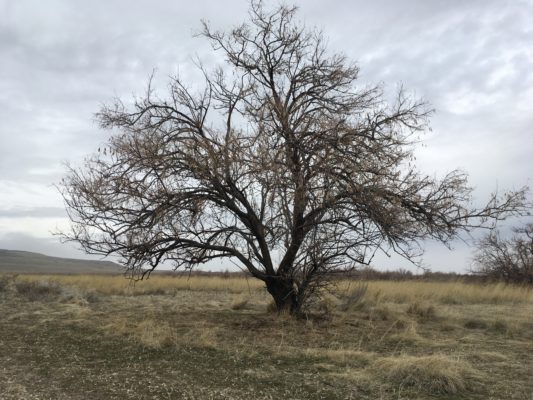
Signs point to YES. I’m both more emotionally free from fear of commitment and more enraptured with images that inspire ink. Circles, moon phases, heart expansion, and trees are all on my mind.
……..
Title of this post gleefully stolen/adapted from a play/film you should watch to see dialogue in masterful action: Glengarry Glen Ross, the “coffee is for closers!” scene.
I’ve heard people say that you can read any number of books whether fiction or non or self-help, and they might be interesting but they won’t actually get you out of your rut until you are ready. This has been said about addictions, too-that you can quit 62 times or 3 times or 17 times but when you’re actually ready to be done, THAT will be the number that does the trick. If there was ever a reason to just keep trying, that’s evidence enough.
Last summer I was driving across Colorado from California, listening to a podcast interview with a fascinating woman named Steph. She’d been a monstrous skiier in the footsteps of her father and reinvented her life with a record-breaking year of travel and vertical descent, then wrote a book about her transformation. Not into a world-class athlete, but into a woman who had integrated her feminine and masculine sides into a whole and happy person. She was unhappy with her life before but had not hit any kind of rock bottom, and that hooked me. So many transformation stories seem to require that hard reset, that desperation borne out of hardship or trauma. Not Steph’s. She validated the “this isn’t good enough yet” life reboot.
By fall, I was also ready. 365 days ago I took a leap of confidence and joined Steph’s 3 month coaching program called the Great Big Journey. It promised nothing short of lifechangingness. That is, of course, if I put in the work and showed up and created and discovered what I needed for kicking myself out of ‘good’ into ‘amazeballs’ (my depiction, not hers).
Within a few weeks I was making connections between my history of authority-based relationships and my inability to choose something-anything-to steer my ship towards, whether work or love or location. Something had to change or I’d be in the same place at 54 as I was now at 44. And 34. During phone calls that alternated between frantic notetaking and impromptu crying, I found new meaning and some ways to find my goals.
But I still needed to act. Self reflection and self awareness are (a little too) fascinating on their own but they do nothing if I wasn’t going to actually DO something.
And do, I did. I rekindled old friendships that I couldn’t maintain before. I fell in love with one of them and had my heart spectacularly broken, and yet I reveled in it all. I became a poet, a bit of an extrovert, and a lover. In that same window of time I moved to Salt Lake City and those “little” changes set me down yet another new path of joy and connection.
Is everything perfect? Fuck no. Fear is managed, not extinguished. Love exhilarates and blinds at the same time. And work… well, work is still a perpetual mix of creativity, grinding away, and timing. I’m an amazing writer and my clients are out there to be found and cultivated.
But what has changed that still sticks with my enriched life? At least this:
Nearly overwhelming ability to feel my full range of emotions. Sounds boring or like a skill that everyone has, but it’s not. I didn’t let myself feel anything too deeply for 40 years. That’s a scary process of unlearning.
Less dependence on authority relationships, particularly with the men in my life. I have more than enough ability to make decisions and take actions with my own authority. And my relationships are closer to equal partnerships than ever before.
Many more friendships, and the deepening of all of them. Exactly one year ago I had one, possibly two friends that I would be able to call in a moment of crisis for understanding and an ear. Now I have a half-dozen, maybe closer to ten. That alone is a massive shift. It’s evident in my interactions with all my friends, this connection and commitment.
Despite the trepidation over work and finances and the ups and downs of feeling your feels and the risks of love and loss, I am HAPPY.
Last spring I took a packrafting safety and rescue course. We learned that as a swimmer in distress (aka pre-drowning-victim) you must have agency to be saved. It is not enough that an expert lifeline is thrown. YOU MUST REACH. And grab. And hold. And keep swimming. Your participation in your rescue is not optional.
At UTMB last week a lifeline appeared right at the time I needed it, but I had already decided that drowning was inevitable. I walked away.
This is that story.
Chamonix, late August: Terrified
When friends asked me how I felt in the days and hours before the start of the 170KM UTMB race, my standard response was “terrified”. The magnitude of the trails, the potential wet weather, and my injured achilles tendon had seriously fucked with my mojo (not to mention two hard 100s already in 2019, and some challenging interpersonal drama). Other months I might have been able to reframe my story, to tell myself, “I have no expectations other than enjoying the spectacle.” Alas, that was not my mindset, and mindset is everything.
Prior to the achilles thing, UTMB was supposed to be a “frosting race” to cap the summer. A time to use my training experience to get through the course without stress or hurry. I set modest goals: first a finish and second a decent time, perhaps approaching 40 hours. After the injury, the first goal shifted: no serious injury that would put me out for months or more. The other goals? Demoted to meaninglessness. Honestly, I fully expected the achilles pain to announce itself early and loudly and I’d last maybe 20 or 30 kilometers before hanging it up, smartly and with no “didn’t tough it out” regrets. The worst case scenario was frightening: pushing through pain only to rupture the damn thing on a remote mountain pass.
Chamonix, 3 p.m. Sunday September 1st
If you’d asked me 24 hours ago what I would be doing at 3 p.m. on Sunday in Chamonix, I would have assumed jogging through the streets of Chamonix-Mt-Blanc with new friends and a ton of grit (literal and figurative). We’d all be exhausted, jubilant, relieved, and overwhelmed by the noise of the crowd and the sight of the UTMB finishing arch. As it turned out, my friends were indeed doing their celebratory final steps after 45 hours on the trail. I was within earshot of the clamor blocks away, in a haze of processing and self-pity.
Fifteen hours earlier, under the dark cover of night with 50 kilometers remaining, I chose to quit the UTMB. At the 125km Champex Lac checkpoint, I walked up to the table that said “Abandonment” and let a woman cut the barcode from my race number. I lied to myself and to the race official, asserting that I “would not complete the race”. For me, there would be no more checkpoints, no more stretches on off-kilter trails strewn with runners sleeping on rocks, no more procession of lights ahead and behind me as far as I could see. There would be no more pain in my groin on nearly every step, no more nauseatingly soupy mud-fests that used to be trail, no more soggy pack, no more force-fed energy gels, no more gut pain with every stride.
End of the line.
Earlier in the evening my stomach had gone way off on a fast and technical downhill to try to outrun a storm (didn’t work). The daggers in my gut only magnified the conviction that I was not fit to continue. That I was at risk of serious injury. That I was not prepared for this endeavor, not this time. It all seemed so inevitable.
UTMB Start, August 30, 6pm: Quadkilla?
During the race, I carried no painkillers. I needed to FEEL what was happening in there. This meant that early on, the achilles was indeed unhappy. Tight, a bit sore, and certainly giving me warning signals that I was noting and then ignoring. For now. I keep popping my hippie anti-inflammatories (fish oil and turmeric – brilliant, FYI) and plodding up the conga line climbs into the first night. I have never had so many people behind me in an ultra before. I have never had this many people ahead of me in an ultra before. Amusing and amazing.
Here’s how UTMB goes: the average angle of climb or descent is right around 12%, similar to Hardrock Hundred. However, the flattish miles at UTMB account for a higher percentage of the course, which means the ups and downs are far steeper. And hoo boy, my quads were announcing loudly their disdain for the extreme angles and bumpy trail. This is when I need to call on my extensive experience to remind myself that this happens. This is OKAY. The quads might seem like they’re going to implode at 50K, but they will not if the calories keep flowing.
Achilles Yay, Iliopsoas Nay!
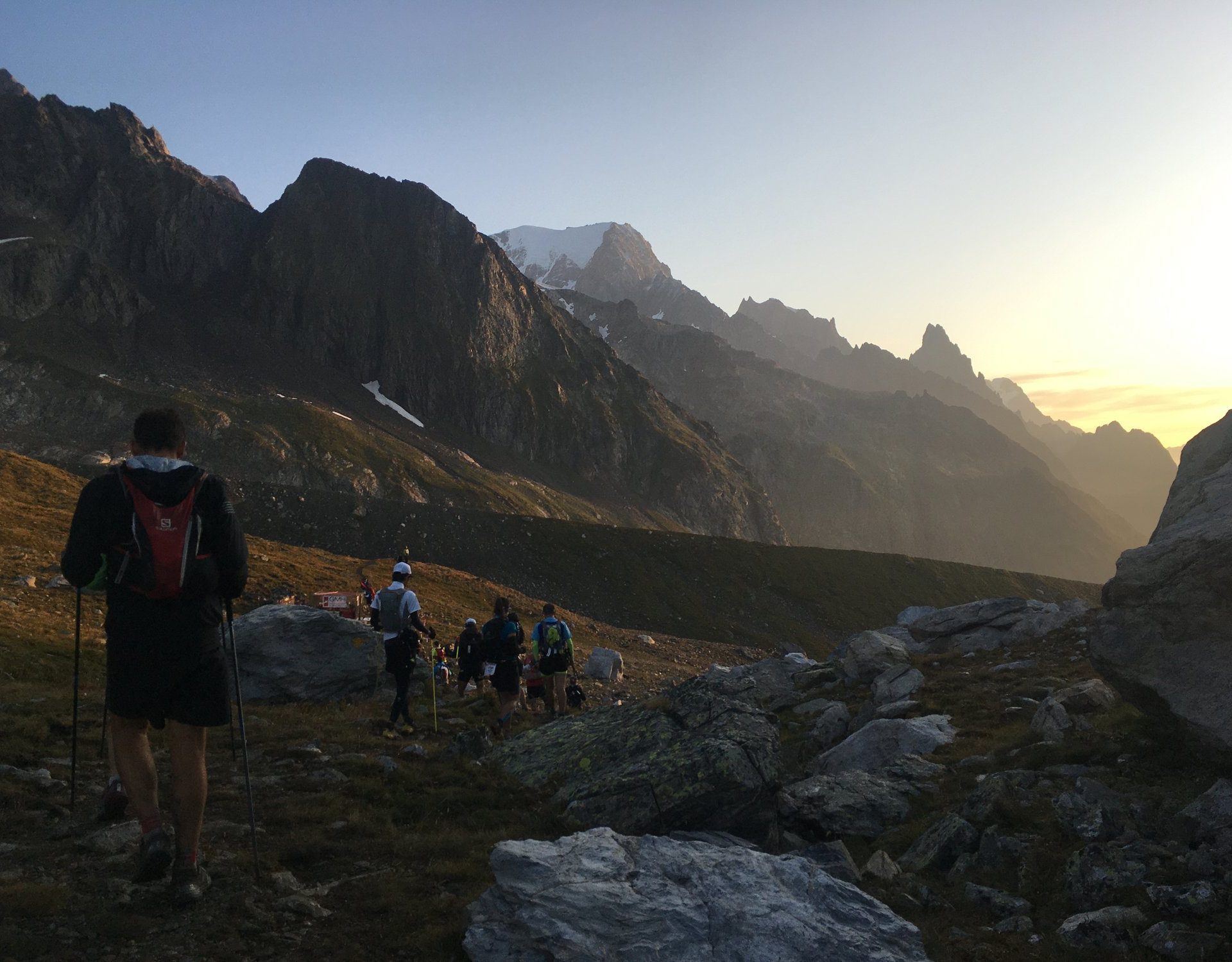
Despite the quad complaints, the evening and first night and day had been going relatively well, considering my fear around the achilles. I got through 20K, then 40K, then beyond 50K with no progression of the pain, possibly no threat of further injury. Très bien! And holy cannoli, the sunrise on the Italian border pass just made my entire year. On that pass I decided that I must come back to this amazing place, over and over, year after year. But after every blissfully grinding climb at UTMB there must also be a descent into hell.
Entering Italia
Around 60K, the downhill & flat running combo awoke my iliopsoas—an on-and-off injury for more than 2 years. Was this another warning from my body to stop to prevent real damage? Every single bumpy down on this course was followed by flat running and a fair bit of cursing.
Here’s the weird thing with injuries and pains and things that go bump in one’s body in the nighttime of ultras: they might not be anything at all. Or they could be THE THING that puts you in cross training rehab hell for a year, or more. My brother nursed a deep groin injury for over 5 years before hanging up ultrarunning for an actual life. That shit gets me paranoid. Luck probably plays a part in how it turns out, but knowing one’s own body helps immensely.
Through Courmayeur after a rooty downhill trail that would make HURT 100 proud, I changed into lighter clothes and got a burst of new enthusiasm for our next climb. Before leaving, I saw a runner with a mug that said, “WTF” and commented on it. He replied, “it’s not what you think…” and I chuckled. This is Paul from Ireland. I’d be seeing a bit of him over the next 12 hours.
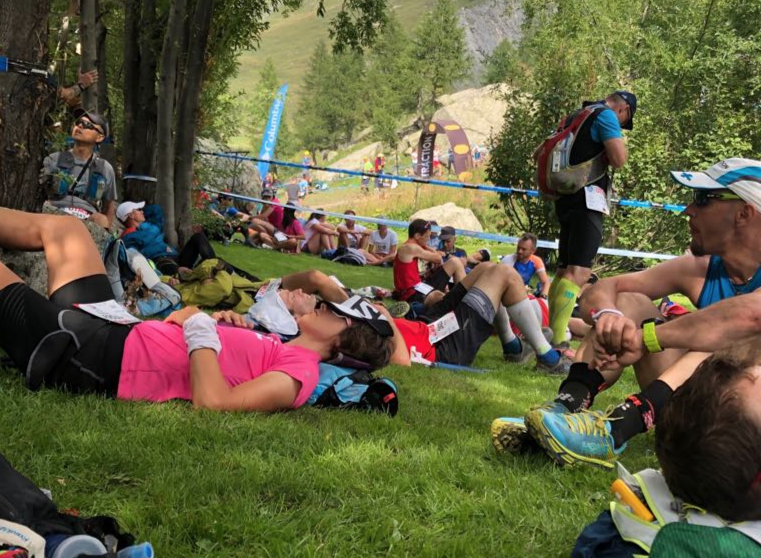
I relish climbs. I grind, I pass people, I get it done. Usually in ultras I am asking, “when could I have another climb, please???” Which is why I’m drawn to stuff with big power climbs like UTMB. We ascended to an airy pass at a ski resort and then down to the next checkpoint with a fabulous shaded lawn for a 10 minute nap.
Yep, that's me in pink Vfuel attire.
Mentally, I was all over the place. Up then down, ebbing and flowing with my muscles and heat load. Next, our highest point at Col Ferret. On the ascent a storm rolled in providing welcome shade, but I knew we might get nailed. Sure enough, the fat drops came and the lightning-thunder gap was down to 3 seconds. I was ready to GTFO this mountain. When the 10 kilometer descent was described as relatively runnable, I was prepared to suffer the quads down to La Fouly to avoid as much of the slop and lightning as I could.
Storm Drain
Through a rainstorm that sent rocks down, blocking several roads, I ran HARD down the mountain into La Fouly, Switzerland. The trail, once we reached the woods, was absolute wreckage. Soft squishy pudding mud while it was still downpouring. The trail was the stream. The stream was the trail. I managed to not slide/slip/fall and coat myself in the muddle. But through all that running and desire to just get to the next checkpoint, BOOM went my gut.
[Side note: I don’t get stomach issues. I’ve been extremely lucky this way. I don’t get nauseous, I don’t puke, I have low appetite but can usually put food in. So this gut thing on the La Fouly descent was unfortunately unexpected and overwhelming to my (then) fragile mental state. Jason Koop writes with amazing insight about UTMB when he describes a likely DNF as a person with multiple issues that they are trying to address or think about all at once. One issue? You’re fine and nearly all runners will plod through with one issue. But two? Three? Odds of DNF start skyrocketing. ]
Even with my now multiple issues, I got through La Fouly and started on the next section, a “rolling” 7 kilometers to Champex Lac. Along the way (frankly, as I sat on a bridge still in La Fouly hating life) I met up yet again with Paul who tugged me along with another friend through my whines and (silent) desire to stop. Running sucked. Walking sucked. Sitting down compressed the stomach and sucked, too. After a bit, I let my pity grow enough to let Paul & co get ahead of me. Now I was alone in the dark, with another runner or two or three coming by with regularity. This was demoralizing. This was mortifying. To stop UTMB seemed both perfectly logical and yet oh so dumb.
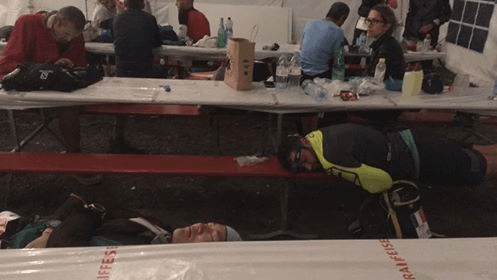
And the fun continued to Champex Lac with multiple stops for no good reason at all. Being upright in any configuration hurt. But, I had nearly 2 hours on the cutoff so I planned to lie down and sleep for at least a half hour at Champex to reboot the gut. I joined the morgue of sleepers on picnic benches and conked out. My alarm went off and I swung upright and the gut rebelled. Gawd. Damn. It. So this was it. I was done. 14 more hours of gut pain? No. Nononononono. That was my brain. That was all I could think. Fourteen more hours. Fourteen more hours. Fourteenmorehours.
Bench morgue. Champex Lac.
Just then I found Paul again. He was about to leave. I said I was giving the stomach one more try with some rice. I didn’t tell him I planned to stop. He said, “Do you want me to wait for you?” I immediately responded, “NO.” I hope I also mumbled something nice about not wanting to take up more of his time, but my memory is shit. And that was that.
Lifeline: rejected.
No Regrets = No Growth
As it turned out, I did in fact meet my first goal—to not render permanent injury. But a massive shitstorm of second-guessing and regret came almost immediately after the bar code was cut from my bib. (Maybe I could reattach it and undo??? Maybe…??) Much of the doubt came from suspecting that I could have still had my non-injury goal while still finishing, even if slower than planned. Had I said yes to Paul, there’s a damn good chance I would have finished. Simple as that. Sometimes it’s a door you walk through, and sometimes it’s a door you close.
Getting on the bus back to Chamonix with several other DNFs, the doubt was immediate. I could walk. I could keep going. Others seemed worse off. Why in the hell did I stop? I didn’t “deserve” to stop! One guy across from me was in his own world of funk, the UTMB running figure logo tattooed on his thigh. I looked at him, wondered what he was going through. If he couldn’t continue, or if he regretted already, too.
Regret is a tricky emotion. It MUST be funneled into positive action and mindset otherwise it will ruin you.
And this is why we process. When I take my experience running 75 miles through the Alps and really think about what I saw, what I felt, and the enormity of the event, I’ve got to believe that there’s little to regret. I came away with at least two new long-term friends (yes, Paul is one), and boy do I ever know what it takes to finish this course well for the next time I’m here. Of course there’s a next time.
Life has no guarantees. I might not get selected in the draw for 2020. This is how the game works. I am repeatedly reminded that I can choose better actions after making a questionable decision, but I might not get the chance again. I hope to keep choosing better before my time runs out. I’ve been running ultras for more than 20 years, and still I learn. Every single time, I learn.
“it takes a hard-won maturity to experience the depths of regret in ways that do not overwhelm and debilitate us but put us into a proper, more generous relationship with the future” – David Whyte
The After After: Advice
Take the lifeline. When the rope is thrown, no matter how much you think you can’t swim, paddle anyway and grab on.
Paul offered me a chance, though neither of us thought it significant in the moment. He didn't know I was literally about to go get my number cut off, and I didn't want to mess up his race if he waited too long for me. My stubbornness rejected it even before my head and heart could give it the consideration it deserved. Other runners had different lifelines that they were able to use. It might be an expectant crew. It could be kind words from a volunteer. Sunrise. Coffee. A nap. Paul’s was a photo of a friend now passed. In a race this long, we all need some kind of lifeline, however small. We have to bring them with us, or find them in the moments of doubt.
Delta flight 5724 from Salt Lake City to Burbank is completely full. This is not difficult given that it is a microscopic plane sporting 2×2 rows all the way back with the exception of first class which flaunts its four rows of ultra-wide 1×2 thrones for all of steerage to see.
Tomorrow, I hop on a United flight early enough to require a 6am airport drive for the impressive 5 hour flight across the continent before another 8 hour hop to Geneva, Switzerland. My body will land 15 actual but 24 clock hours after I begin. Upon deplaning I will immediately begin the breakfast routine of a country not my own. Coffee? Ya. Pastry? Not quite yet, merci.
Back up… There’s more to this prologue chapter.
My Achilles Heel Is… My Achilles Heel
Two weeks prior to race day—8 days ago—I was jogging the streets of my neighborhood, breaking my usual routine to watch a local cycling race that looped around city streets for hours on a Friday evening. drawing a weak number of spectators plus me. I darted to catch almost dangerous views of tangent cutting and pace cars. But one of those sudden starts landed a dart right in my Achilles, near the heel. Like most runner addicts, I limped a bit, ran some more, and then ran some more. No biggie: the next morning it would be fine, and I could get in some of my last anticipated runs before a massive taper in the last week.
It wasn’t fine.
Waking up reminded me precisely of the darting pain from the night before. Immediately I knew this was A THING and I was none too happy. I walked, a little. My stubbornness gimped down to the coffee shop asking my body to answer just what the fuck was going on in there. The unhelpful answer was, “you hurt me, idiot”. (To be fair, I added the “idiot” part. My body’s not that cruel, normally.)
Back up, even further this time.
The Signs Pointed To: Rest
I’m tired.
Since September I have run three 100 mile races, all of them deliberately and with what counts as speed in my body. September’s gorgeous Stagecoach 100 took me over Babbitt Ranch land near the Grand Canyon in heat and sun to exactly the finish I wanted. I celebrated. Then I fell calamitously in love with an old friend and rode the vibes to a November personal best at 50K—a record I’d previously set at age 30, which was a long time ago. Winter brought a move to my new lovely hometown of Salt Lake City and a reboot of many personal motivations and values. Through heartbreak and upheaval and new romance I trained and trained and ran the race of my life in late March, my first win in a 100 mile event. It was a very good day.
The week after my March race I ran over 30 miles and almost couldn’t believe it.
I felt…. fine. Of course I knew I ran a hard race, but the miles did not feel heavy or wooden, so I listened. Spring passed as I prepared for my third round at San Diego 100 in early June. Without complications, I had a difficult yet satisfying race. But after San Diego, the recovery looked different. The miles were harder. The legs were heavier. With that new bodily information, UTMB was definitely looking like it would be a “get it finished” kind of goal. My body was ready to stop racing for the time being.
So the mileage stayed reasonable through the doggy summer days of Utah. The weeks ticked down to the UTMB trip with all its planning and packing and mandatory gear and weight limits and hooboy. So much planning for this event, relative to most others where one can show up with some running clothes and a jacket and get through the day. Here my kit will weigh at least 5 pounds before water, not a burden but certainly more than the usual carry even for all-day runs.
But I can finish. This much I KNEW.
I might even want to finish well ahead of cutoffs, perhaps 39 hours instead of 46 is a reasonable goal…. that would be lovely.
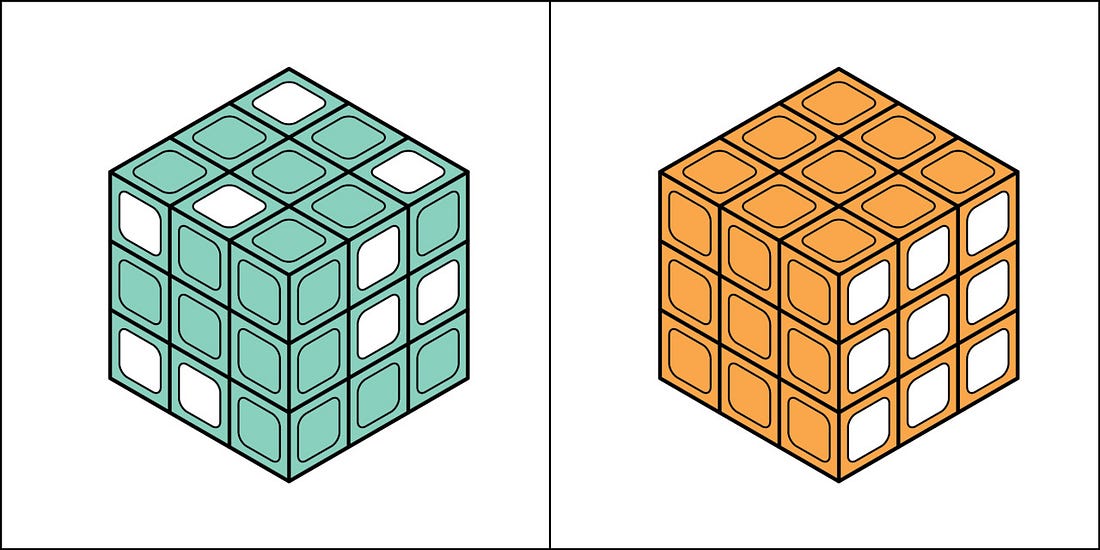
Those who get up with their alarm and those who snooze 11 times.
The never-complete and the set-and-satisfied.
Those who keep their curtains wide open, and those who prefer drawn shut.
Those who “eject USB device” and those who just YANK THAT THING OUT.
The seekers and those already found.
Those who love tacos and those who clearly must hate all of existence…
I’m in the green group, for now….
Humans categorize. We sort. We pigeonhole. It is what we do to make sense of the other people around us. We were doing it when our social circles maxed out at about a hundred people, let alone now when we can see and be seen by thousands and millions and billions. [This tendency can also be used to do the basest evil which always begins with sorting people into the “my side” and “others”. Bad, bad, bad.]
Sorting Works? Sort of!
And yet, maybe there is some validity to seeing not so much differences that divide but rather the DIRECTION those differences imply. What if in sorting those people who surround us into “all the laundry together!” and “whites/colors/darks, you morons” we are actually sorting into personal philosophies of unsatisfied curiosity versus comfortable familiarity? That is quite useful, especially if you would like to embrace and promote one side or the other for this stage of your life.
By using the “two kinds of people” assessments, we can decide to assist our own path by surrounding ourselves with those in alignment. Find the tribe that suits us, at least for now. Maybe that tribe is the mortgage-paying, or maybe it is the rent-paying. Maybe we are better served by jumping from the meat tribe to the veg tribe or back again. Or we make the simple habit switch from electric to manual toothbrush.
AND you can use this power as a weapon for GOOD. We all will be just a little bit happier as a result. It turns out I have a lot more to say about this.
The 1980s had dozens of television commercials about the benefits of phone calls. They could save you a trip to a closed business, start a pep talk with a family member, or get caught up with a friend. Some were from the yellow pages companies, some were from the local phone companies. Most featured tag or jingle lines like, “phone first!” or “reach out and touch someone” or “just call”. Even now with the ubiquity of smartphones, you can still save time calling ahead. Even with Yelp and Google and the businesses’ own website . . . the hours still could be wrong. But it’s more than that; it’s not just the avoidance of wasted time.
Introverts hate picking up the phone. Often, it’s a hate with fiery and sweaty-palmed passion. Same thing for the shy, the awkward, and those on the autism spectrum. This means about 30% of the population would rather risk being wrong or missing a crucial piece of communication than making a phone call.
But here’s the thing. Introverts also dislike spending more time than needed on interactions with people. If I do not call that auto repair place because they are open for another hour on their Google listing and when I arrive they are about to close, I now have to interact with THEM, as well as the next place on the list.
This does not just apply to business hours. This is even more important in business RELATIONSHIPS. At work, the difference between picking up the phone and writing an email is so night and day that extroverts laugh at our silliness and reluctance to talk to a human.
And after decades in the workforce, it is still hard to remember that one 10-minute phone call can prevent hours and dozens of emails. Not to mention you now have a “face” to that other person and they are far more likely to work with you in the future. Why is that? Because most of the time the person that I (and you) need to call is an extrovert. They wouldn’t be in that sales or marketing position if they were not. So they LOVE phone calls. They EXPECT phone calls. For them, that’s all well and good.
For us, they’re a necessary hurdle in our quest for efficacy in life. See it this way: the more times you pick up the phone, the less time needed for carefully worded interactions in the future. And possibly less time needed for interactions AT ALL with that person in the future. So for an introvert, that’s a win.
So here’s the big, magical toolkit/tip/hack: MAKE THE CALL.
This tip was written with business in mind, but it applies 110% to personal relationships as well. THAT might be another post for another time.
Photo by Tony Christensen. Given that I had a song called "Moderation" stuck in my head, this is apt.
from now on / with the sky as my roof
from now on / let the risk lead me to
from now on / somewhere I never knew
"Royal Blue", Cold War Kids
Last Saturday, I finished Antelope Island Buffalo Run 100 under my original goal time with trail conditions less than ideal, all while smiling far more than I thought possible for a rainy day out on an island surrounded by ornery bison.
I knew my legs could run the pace I intended; I’d felt it in my body and mind for months. What I didn’t know was that it would all come together in a bouquet of glowing sage and hopscotched puddles and an overall win for me: it was a day of firsts.
So, what actually happened out there? Was it just a magical day for me alone? Or did my exuberance extend beyond my bubble of bliss and bleed out into the ether of others. I hope so, because it truly was a goddam amazing day out there. Everything I hoped for happened, and then some.
Last fall I set a goal to run sub-24 hours on the Stagecoach 100 course in Flagstaff. I met that goal and finished in 23:28, but my GPS as well as most others only tracked about 95 miles. This tugged at my brain for months. I made my specific goal, but did not feel like I had done the more meta-goal of running 100 miles in less than 24 hours. And then, with a blazing fast 50K in November logged on the now-familiar Antelope Island trails, I was heading into my new hometown of Salt Lake City and winter with excellent fitness. I wanted to capitalize on this.
I ran more than most here in Salt Lake City do in the winter. Many of the trail runners are out on the ski slopes, trudging up peaks on snowshoes, or (horrors!) taking some needed time off. Not this one. These legs were continuing to pound 50 mile weeks, sometimes on snow, sometimes on pavement. And nothing was breaking down. Yet.
Early February brought RUFA's 12 hour race, a good chance to see if my overall fitness was workable. Indeed it was, with 4 snowy frigid laps completed in just over 9 hours. Even with time enough for a 5th, I called it both a day and an excellent training run.
Only two weeks before the race I finally realized the start time was 10am. This is a massive bonus in logistics. Why? Here's what happened race morning: I woke up after a full night's sleep in my own bed at 6:30am, made coffee, did morning rituals (ahem), and then got in my car at 8am to drive to the start where I was one of the first to arrive and got front-row finish line parking. SCORE.
RD Jim Skaggs said his friendly hellos as I shuffled my final drop bag contents due to the drizzling forecast. Where should my many jackets go? Where should I put my knickers? Should I start in shorts? Waterproof jacket or no? By 9:50 I'd gotten everything ready, did a short meditation in my car, and stumbled out into the crowd. And we were off.
Photo by Tony Christensen. Off we go into the wild grey yonder (me in black hoodie on right)…
My goal? A sub-22 hour finish, which would be a 100 mile PR by more than a minute per mile. My plan? Go harder than I ever have in a 100, and see where this theoretical redline might live. Can I toe the line and not fall apart? Now, the weather presents new challenges. The trails of Antelope Island State Park are insanely runnable when dry and tamped down; not quite as runnable when wet, sloppy, or tracked out by horses and dried to lumpy.
In the early and climb-heavy miles I chatted with a few folks, including my friend Ron Hammett from Las Vegas who ran Stagecoach with me last fall. We talked about goals and weather and trail conditions. I hinted that I had a "secret" goal that was not time-based, and he smiled. I noted that I wouldn't make any commitments or decisions until I saw how much time the mucky trail was going to take off my pace. No matter my speed, my plan was still to go hard and take risks, and think of my secret goal every step.
And yet.
Every single mile The Strava Lady on my phone informed me of my previous mile's pace. This was intentional. This was to keep me on top of what I was putting out. This was hopefully not obnoxious to anyone in earshot. I knew that for a sub-22, I needed to average just over 13 minutes per mile, including aid stations and everything that would subtract from actual moving pace. This means any time I heard a number well under 13, I felt good. When I heard a number well over 13, I felt less good. Of course, there are climbs and descents; these all contribute.
The trail? Hopscotch-worthy. Some runnable and actually kind of nice. But chunks were mucky and disgusting and worthy of puddle hopping to avoid soaking wet feet. I ALMOST took a fall when sliding down some slimy mud in the early miles, but saved it and didn't strain anything in the process. Yet my pace was still…. pretty good.
My first bison encounter could have been worse. Somewhere around mile 18, we contoured around a hillside strewn with rocks and outcroppings. I saw a runner in front of me veer way off trail to the right, and wondered why he was going so far for what seemed like a pee break. Soon, he turned around and pointed, and I looked LEFT to see the bison, just feet off the trail and dead ahead of me. WHOA!!
Once out of the path of potential stampede, a certain Fight Club scene came to mind. I of course riffed on it immediately to fit the situation, laughing out loud like a crazy person.
WHOA! WHOA! OK: you are now attempting a run with your imaginary friends NEAR 2000 POUNDS OF BISON!
The next chunk of trail went, well, fine. More mucky crud around miles 20-23 but more or less runnable. And then I was on the trail I got to know so well: Mountain View. 11.5 miles each way of flat singletrack along the shore of the lake. I'd run it often in training, and we'd do this stretch 4 times during this race. I was still chugging along. I counted runners and women in front of me as they came by from their out & back. Right now I was 6th woman and about 20th runner. I'm a closer, so this was perfect.
I arrived at mile 33, The Ranch, at a pace that indicated I might be able to pull this off. This was seriously happy-making, and yet, nearly 70 miles to go. Thinking about how many miles I have yet to traipse does not mess with my head. It does not depress me to think, at the 38 mile Frary Aid Station, "oh, I have a 100K race to go yet". It does not drown me in despair to complete my first 50 mile loop in 9:58—one hour under my previous 50 mile PR—and consider that I need to do it all over again, in the dark, and not slow down too much. I am lucky.
I lingered at the 50 mile for 10 minutes and yet that seemed long. All race my aid station stops were mercifully quick and focused, eyes on my goal. A few people said I was 4th woman and 3rd had just left. I strapped on my lights and said to anyone who would listen, "Hey, great 50 mile loop! I loved it so much I'm going to do it again!!!" and headed out in the quickening dark and intensifying drizzle toward Elephant Butte.
100 milers are a fascinating study in mellow focus. There's a flow state that happens when you just go, but not get sloppy. I found this state repeatedly during my race, but especially in the dark. I went past Alicia on this stretch, who said the messy trail took more out of her legs than she hoped. I wished her well and trudged on and through the next 14 miles of up/down/rocky/winding, until it was mile 65 and the gauntlet was done. I'd crossed 100K in another new PR, and needed to keep the wheels on.
No more bison on this next stretch as I blew through mile 70 at the start/finish and readied myself for the final 50K. By now I knew I could make my sub-22 if I kept eating and moving, but one never knows how things can implode, even at mile 95, let alone 70. Again to the Mountain View trail, again through Frary aid, where they told me the lead woman had left "not long ago".
Oh yay. Oh no. I've still got 22 miles to go, and the idea of catching up worries me a tad. Chasing might be entertaining, but being chased? Fucking terrifying. And yet, exciting. With 19 miles to go, I pass Dana and her pacer and hold my pace, putting a little distance on. I spent 8.2 seconds at The Ranch aid station (the turnaround) and see how long it takes before I see Dana again. About 3 minutes, which isn't long. And yet, that's over a minute per mile. Maybe….
How I race: at least after the halfway point, anyway.
I keep going. Back to Frary. Now 11 to go, and every single mile I am calculating how many minutes per mile I need to average to still break 22. It's over 15 minutes per mile now and I feel…. awesome. I pass more runners, one by one. Most with pacers. Some say, "go get 'em!". A few realize that I'm the first woman they've seen go by and they get enthusiastic which goads me on even more.
I text the friends who might possibly be roused from Salt Lake City to come see me at the finish, but it is 5am, after all. Back to the utter slop of the final mile before the fence line. Back up the hill at mile 94, back to the final loop around White Rock campground with the chunky footing of the Lakeside trail. I'm wondering where Dana could be. Is that light behind me her? The next light? Did she rally? I keep moving through the final aid station with barely a glance at the table.
And then, I can see the finish, a long two miles to go yet, and with just enough light that I turn off my headlamp and handhelds. Just in case someone behind me is trying to see my light in order to make one push to catch up. Sneaky? Perhaps. But I needn't have worried. The last bits are on road, first pavement and then soaked gravel. My face almost hurts from all the grinning I've done in the last 21 hours as I turn towards the tent one last time, and let out a WHOOP!
It's quiet here and no one looks official, so I wander into the tent to let them know I just finished. And it's over.
21:32:51 and first place woman by over 45 minutes.
Done, done, done. And happy.
And that was how it went. So many feels for everyone out there on the unutterably gorgeous island with me, from runners to volunteers to family and friends of all of the above. While I did not bring along my own crew, I was still surrounded by friends and felt at home, every single mile.
In the mud, in the slop, in the gravelly sand, in the headlamp lit night, in the misty sky, in the drizzle spit every single hour.
With the chafing, with the nonstop oral IV of sugary goo, with the obscured full moon, with the damp windbreaker, with the furry bison, with the gloves on / gloves off cycle, with the alien glow of the sage, with Florence & The Machine stuck in my head.
Across smiles, across stuck songs, across miles and miles, across slippery trail, across the tread of my brand new shoes, across the hours and minutes as they passed too fast and too slow all at once as they do.
I just sent a cold email to Austin Kleon, asking if I could track him down in Pasadena for a "totally non-awkward" hug. This is what the digital age has done for introverts: we can reach out, nicely, from our trembling seated positions to those that we would like to appreciate. It could be an email. It could be a letter. They owe us nothing, but we receive the tingle of optimism for what might be.
It's good to offer something to those you admire, other than a hug. It could just be a story about their impact. "You have made a difference to me, and here's an example of how." A real story is better than just a thank you, but even those are okay. After I sent a letter to Natalie Goldberg thanking her for transforming my approach to the writer's life, she sent me a postcard back from New Mexico. You never know what delights await.
Natalie Goldberg sent ME a postcard. Squeeee.
Important side note: it's not good to ask for free advice (though if you do, put it FIRST, not after a whole string of buttering-up platitudes which ultimately make them suspicious of anything you might send in the future). It's definitely not good to ask to be mentored. Mentorship from a stranger is a fantasy that never works out well for anyone.
As to Austin? We shall see if he responds, positively or at all. In the end, I can feel good with the message that I sent, even if it goes into the ones-and-zeroes ether.
I’m at the rear counter of a curio shop, ordering a mocha latte for my aunt Dolores. The owner, a woman in her 70s, is describing the size options to me in a not-abundantly-clear fashion. The small sounds rather small but is not terribly expensive though a number is not given. The large is $15 for newcomers, less for repeat customers. And two are, of course, $30. Because I am who I am even in my dreams, I order one small and wait for the cup.
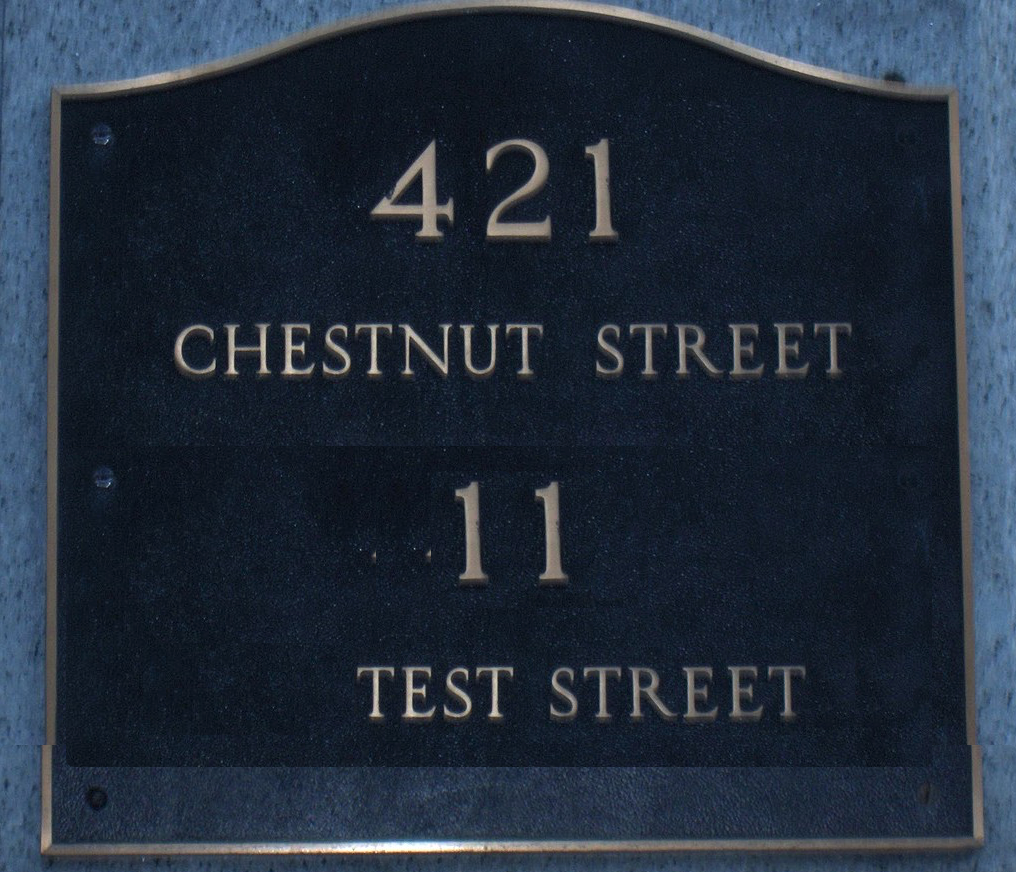
My aunt and other traveling companions, who may or may not include my mom and other family members, are outside, admiring the small town views of rural highways and endless land. Before I went inside, we were remarking on how each house had two addresses plainly written on their exteriors or mailboxes. It kind of looked like this, for each and every house we spied while walking around town:
A house, with divided addresses, cannot . . . exist?
This was a curious practice; I suspected part of the reason my aunt pressed some money into my hand and told me to go fetch her a latte was so that I could ask the locals in the shop what was up with the house addresses.
Through eavesdropping and some small inquiries, I had an answer. Turns out that there is a nearby town, larger, used for shopping trips and the like by the residents of the small town. The larger town has essentially consumed and absorbed the residential contents of the small town, though the small town seems to be suspicious of this. The two addresses reflect the locals’ shifting realities and inability to accept the larger city’s grand plan. One address is their official location relative to the larger town. The other is the small town address, from which no local can bear to part ways. Hearing this explanation made some sense to me, and I prepared to relay it to my travel partners. Just as soon as I received my potentially-expensive mocha latte, that is.
But before I could see the looks on their faces upon hearing the explanation, I woke up, wondering what was going to happen next. In reality, what happened was I took down some notes about this dream. And then I began musing on this dual-address state, not just of residence but of mind.
How often do we find ourselves with two “locations” in life? We are both children of our parents and adults (or even parents ourselves). We can be both an independent person and a spouse (with or without a new legal name). We can exist as a lover to a stranger and a stranger to our families. And often, for those who overthink our lives, we can exist as a fully realized adult human with accomplishments seen by our acquaintances and friends and yet feel like child who needs to get on with adulting to ourselves.
While our many statuses can act in concert to balance out our life goals or current choices, they can also act in opposition, causing suffering that is unnecessary. We contain multitudes, indeed. Each of these possibly dueling states has a “location” within our minds—and in the minds of those who surround us. Unlike those houses of my dream, we rarely wear both of our addresses at once. One is outside (the parent, the functioning adult, the artist) and one is inside (the dreamer, the child, the wanderer).
To boldly show both of our faces at the same time, both of our “addresses”, to the public at large is a rare act of vulnerability. It can make folks uncomfortable to see the duality freely acknowledged. Like when you see a politician cry during a speech. Or you see a woman breastfeeding in a business suit. Luckily, we live in an era that is starting to accept our many facets. That’s progress. Those examples I gave above might still raise an eyebrow, but they would have been unheard of—scandalous—a few decades ago.
What are your locations? Are they in neighboring towns, or are they antipodes so far apart there’s oceans and earth to keep them separated?
P.S. The original intent for this thread was to dig deeper and explore the history of name-changing for marriage and the cultural implications thereof, but it went in another direction, as thoughts often do. Perhaps I will explore the spousal tradition inquiry in a future post.
The second time I passed the parked car on my daily run, I mustered up the courage to look inside. I wondered if I would see cold white skin and sunken cheeks and eyes that no longer saw. Instead, what I saw was a middle-aged man, reading a book. “Well, that’s interesting”, I thought. Then I started paying attention more often to these parked cars. The details varied, but the underlying behavior was the same: individual people getting some “me time” in the City of Angels.
A City of Cars
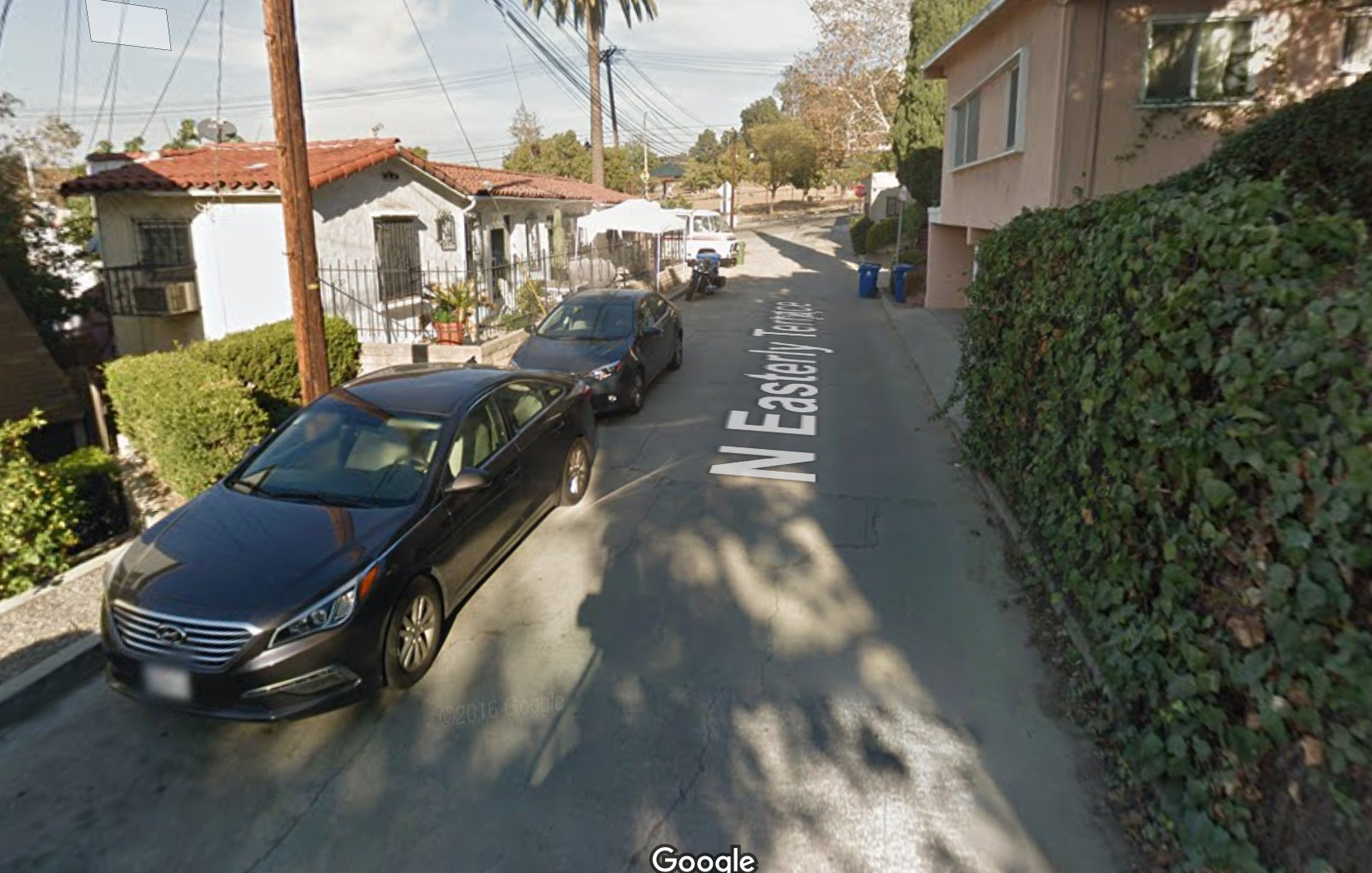
My apartment for the previous 3 years is smack dab in the middle of a gentrifying neighborhood in one of the most stereotypically in-love-with-cars cities on the planet: Los Angeles. This city is a stupendous mish-mash of roadways, from Euro-narrow two-lanes that are functionally one-lanes because everyone parks on both sides, to 33% grade nail-biters (Los Angeles has 4 of the top 10 steepest streets in the country, beating out San Francisco’s TWO!), to avenues in old residential areas wide enough for four lanes. We residents of Los Angeles get to experience everything, along with traffic and parking issues aplenty.
Yes, this is a two-lane street. Theoretically. Make sure your backing up skillz are solid.
Finally, I started noticing people in their cars. Not stuck in traffic. Not cruising along in the HOV lane. But alone, parked. First, I just figured it was slightly sketchy. Maybe it’s someone passed out? Or . . . DEAD?! But then I really started LOOKING. Impolitely, perhaps, but looking nonetheless. Like I described above, the situations I saw were NOT the “skeevy looking person passed out in car” or worse. I saw all kinds of people, all ages, all kinds of cars. On any kind of street. In parks. On busy streets. On quiet streets. Before school. In the middle of the afternoon. At dusk. A young professional woman. A man in a sport coat. An older lady listening to the radio. An adult with a book. Another adult with a book. So many books. What is going on?
Consider The Introvert
First, consider the introvert. One-quarter to a third of humans are predominantly introverted, according to the few sites I could find with some semblance of an estimate. This means a few things, personality-wise. For example, introverts feel less energetic after interacting with others, and feel replenished after some alone or non-social time. It also tends to mean that reflection on internal subjects (analysis, philosophy, writing) is more interesting to an introvert. For comparison, engaging with the outside world (conversations, team sports, parties) is natural to the extrovert and it energizes them.
For reasons above, living alone is preferable to many introverts, but this can come at a price to one’s social life and personal growth. But it can also come at a literal price: in Los Angeles, the average rent for a one-bedroom apartment recently crossed $2000. That’s more than 90% of the take home pay for the median per-capita income of $30K per year (which is 25K after taxes).
Compare Los Angeles to another “large-ish” city nearby: Las Vegas. This desert metropolis has a population of 600,000 people. There you’ll find warm weather, ample entertainment, and 1046 currently available 1-bedroom apartments under $1250. Of those, 608 are $1000 or less per month.
Back to Los Angeles, with a city population of 3.8 million people (6x that of Las Vegas). Within those city boundaries, you’ll find warm weather, ample entertainment, and a grand total of 33 one-bedroom apartments available for $1250 or less. Of those, how many are under $1000? Technically, two: rooms in boarding houses of about 120 sq ft. So, that means ZERO.
How do people manage to live here, at all? The answer is simple: roommates. Sometimes, lots of roommates. Heck, the apartment listings here might seem not so bad when looking for that rare $1000-$1200 find, until you realize that every single ad you open up is actually a room in someone’s house or apartment. There are many scams out there, as well. Most apartment seekers just ignore anything that seems like a deal because it’s likely to be misleading or flat out not legit.
Me Time in Your Own Private Heaven: Your Car
Remember all those people? Just chilling out in their cars for no apparently urgent reason? The more I thought about it and the things they were doing—napping, eating, reading, smoking, listening to music—it dawned on me. They are INTROVERTING.
When an introvert works with people and lives with people and is surrounded by people people people, what can you do in a few extra minutes of time each day to keep your sanity? There’s no time to be going up into the mountains or checking into a hotel, or taking WAAAAY too long in the private bathroom at work? You get your solo time in your car. It’s safe, it’s yours, and you can take it anywhere. In New York, car and parking costs might be just too much for this to be an option, but in Los Angeles I believe that solo car occupancy is one way that inward-oriented folks are filling a psychological need. They’re keeping themselves sane, and, in a way, performing a necessary public good.
It’s an inefficient solution, to be sure, with traffic and smog and all of that. But it’s a solution to ponder. I do.